

- Teacher: Dipak Bhadale
- Teacher: Dipak Bhadale
- Teacher: Manohar Vaswani
- Teacher: Rajashri Barvekar
- Teacher: Dipak Bhadale
- Teacher: Manohar Vaswani
- Teacher: Dipak Bhadale
- Teacher: Tripti Karekatti
- Teacher: Audumbaer Sarwade
- Teacher: Dipak Bhadale
- Teacher: Rajashri Barvekar
- Teacher: Dipak Bhadale
- Teacher: Audumbaer Sarwade
- Teacher: Manohar Vaswani
- Teacher: Dipak Bhadale
- Teacher: Audumbaer Sarwade
- Teacher: Rajashri Barvekar
- Teacher: Dipak Bhadale
- Teacher: Prabhanjan Mane
Introduction to MM1: Poetry in English up to the 19th Century
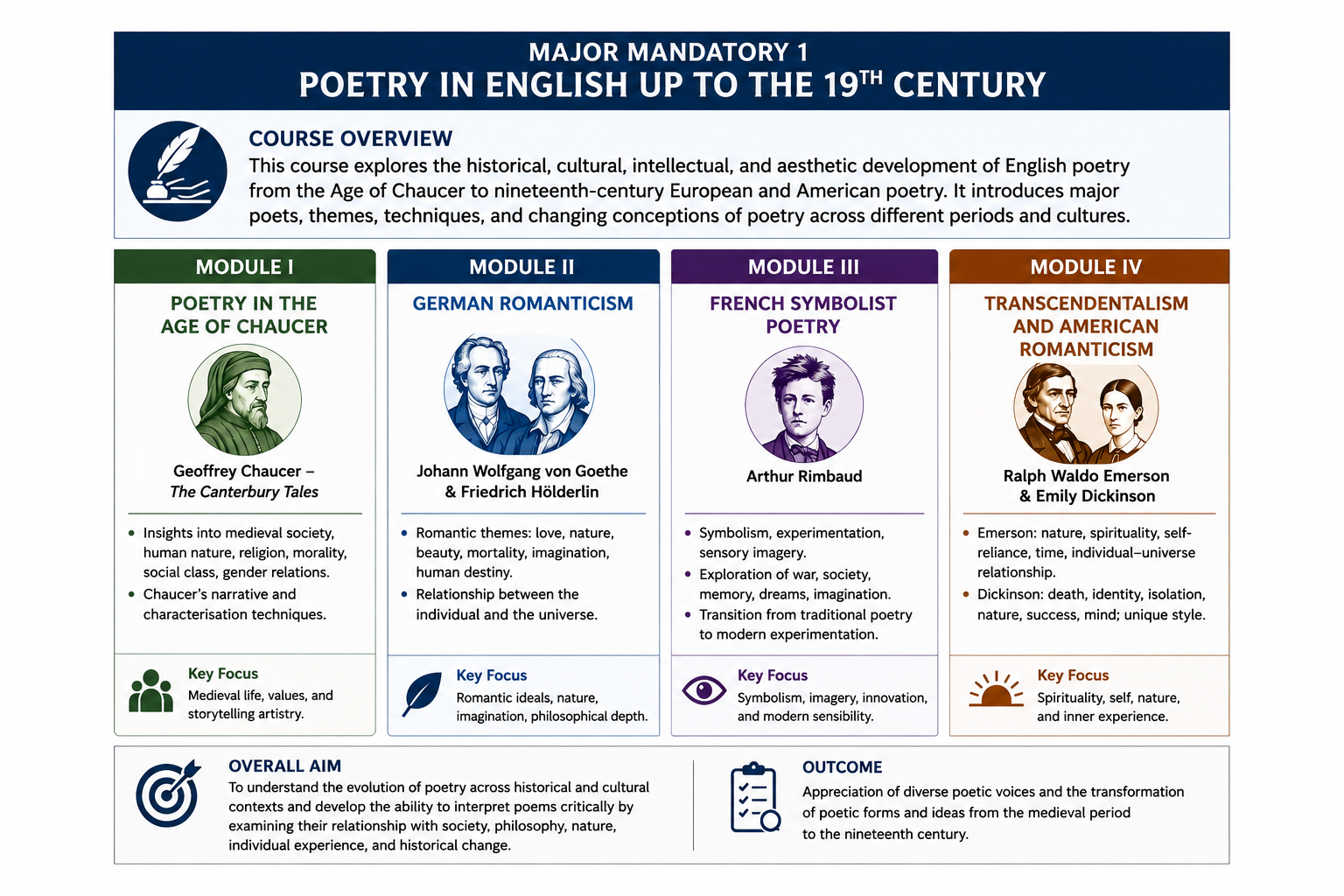
Major Mandatory 1: Poetry in English up to the 19th Century is a comprehensive course that introduces students to the historical, cultural, intellectual, and aesthetic development of English poetry from the Age of Chaucer to nineteenth-century European and American poetry. The course is designed to familiarise students with major poetic traditions, movements, poets, themes, literary techniques, and changing conceptions of poetry across different periods and cultures.
The course is organised into four units, each representing a significant poetic tradition.
Unit I, Poetry in the Age of Chaucer, introduces students to Geoffrey Chaucer and selected passages from The Canterbury Tales. The prescribed texts offer insights into medieval society, human nature, religion, morality, social class, gender relations, and Chaucer’s distinctive narrative and characterisation techniques.
Unit II, German Romanticism, introduces the poetry of Johann Wolfgang von Goethe and Friedrich Hölderlin. The poems explore Romantic concerns such as love, nature, beauty, mortality, imagination, human destiny, and the relationship between the individual and the universe. Students are also introduced to the characteristic features of German Romantic poetry and its philosophical dimensions.
Unit III, French Symbolist Poetry, focuses on Arthur Rimbaud, one of the most influential figures in modern French poetry. His poems introduce students to symbolism, experimentation, sensory imagery, unconventional poetic expression, and the exploration of war, society, memory, dreams, and the imagination. The unit provides an important foundation for understanding the transition from traditional poetry to modern poetic experimentation.
Unit IV, Transcendentalism and American Romanticism, introduces the poetry of Ralph Waldo Emerson and Emily Dickinson. Emerson’s poetry reflects Transcendentalist ideas concerning nature, spirituality, the individual, self-reliance, time, and the relationship between humanity and the universe. Dickinson’s poems explore death, identity, isolation, nature, success, and the inner workings of the human mind through her distinctive style, compressed expression, and unconventional poetic techniques.
Overall, the course enables students to understand the evolution of poetry across different historical and cultural contexts, while developing their ability to interpret poems critically. It encourages students to examine the relationship between poetry, society, philosophy, nature, individual experience, and historical change. Through the study of Chaucer, Goethe, Hölderlin, Rimbaud, Emerson, and Dickinson, students gain an appreciation of the diversity of poetic voices and the transformation of poetic forms and ideas from the medieval period to the nineteenth century.
- Teacher: Dipak Bhadale
- Teacher: Manohar Vaswani
