

The Course is aimed to- 1. Integrate multidisciplinary knowledge in real-world IoT projects. 2. Work effectively with IoT hardware and software tools in practical setups. 3. Understand professional workflows, documentation, and industry practices. 4. Develop and present a project or module addressing an IoT problem. 5. Demonstrate professional communication, teamwork, and ethical practices.
Upon completion of this course, student should be able to – 1. Apply theoretical IoT concepts to practical problems. 2. Deploy sensors, embedded platforms, and communication modules. 3. Integrate IoT systems with cloud services and dashboards. 4. Prepare a technical internship report with analysis and results. 5. Present internship work effectively in oral/viva-voce examination.
- Teacher: Hridaynath Khandagale
The Course is aimed to- 1. Understand the core principles of sustainability. 2. Explain green technology and eco-innovation concepts. 3. Assess environmental impacts of engineering systems. 4. Identify renewable and resource-efficient alternatives. 5. Integrate sustainable practices in design and operation. 6. Promote responsible and ethical engineering decisions.
Upon completion of this course, student should be able to - 1. Explain sustainability and green engineering principles. 2. Identify major environmental and resource issues. 3. Apply life-cycle and impact assessment tools. 4. Evaluate cleaner and renewable technologies. 5. Design eco-efficient and sustainable solutions. 6. Communicate sustainability ideas effectively.
- Teacher: Hridaynath Khandagale
The Course is aimed to- 1. Identify selection and initiation of individual projects and of portfolios of projects in the enterprise. 2. Recognize the need and ability to engage in lifelong learning. 3. Conduct project planning activities that accurately forecast project costs, timelines, and quality. 4. Function effectively on teams and to communicate effectively
Upon completion of this course, student should be able to – 1. Describe the need of a software project for the society 2. Identify requirement analysis like functional and technical requirements for the project 3. Come up with design documents for the project consisting of Architecture, Dataflow diagram, class diagram, Algorithmic descriptions of various modules, collaboration diagram, ER Diagrams, Database 4. Demonstrate analysis and design. 5. Prepare the technical Design Phase-1 report
- Teacher: Hridaynath Khandagale
The Course is aimed to- 1. Demonstrate the Configuration of an asp.net application. 2. Helps to create ASP.Net applications using standard .net controls and to create a data driven web application. 3. Helps to create a Web Application with security 4. Helps to create and Maintain session and controls related information for user used in multi-user web applications 5. Introduce the fundamentals of developing modular application by using MVC 6. Introduce the fundamentals of web services and xml services
Upon completion of this course, student should be able to – 1. Design web applications using ASP.NET 2. Use ASP.NET controls in web applications. 3. Create database driven ASP.NET web applications and web services 4. Handle database using MVC in ASP.NET web applications 5. Understand concept of ADO.NET 6. Configuring and testing web services on web
- Teacher: Hridaynath Khandagale
The Course is aimed at- 1. Introducing fundamental web technologies including website creation, browsers, servers, and HTML for building basic web pages. 2. Developing knowledge of scripting languages with emphasis on PHP and JavaScript for creating dynamic and interactive web applications. 3. Providing understanding of database concepts and MySQL operations for data storage and retrieval in web applications. 4. Building awareness of networking fundamentals and devices required for web and network-based applications. 5. Enhancing practical skills to integrate web, scripting, database, and networking components into simple applications. 6. Encouraging application-oriented learning through the design and development of interactive and information systems.
Upon completion of this course, student should be able to – 1. Explain the working principles of websites, browsers, servers, and HTML tags. 2. Apply scripting concepts using PHP and JavaScript to develop dynamic web pages. 3. Apply database concepts and MySQL commands to store, retrieve, and manage web data. 4. Explain networking concepts, protocols, and networking devices used in web environments. 5. Develop simple interactive, database-driven, and multimedia web applications. 6. Integrate web, database, and networking technologies to design basic information systems.
- Teacher: Hridaynath Khandagale
The Course is aimed at- 1. Developing an understanding of the business environment, management concepts, business ethics, and social responsibility of organizations. 2. Introducing the fundamental functions of management such as planning, organizing, staffing, directing, and controlling for effective managerial practice. 3. Enhancing the ability to apply managerial tools and techniques related to decision-making, forecasting, communication, motivation, and leadership. 4. Providing exposure to functional areas of management including marketing, finance, production, human resource, and materials management. 5. Building analytical and problem-solving skills through the study of inventory control techniques and materials management practices. 6. Encouraging entrepreneurial mindset and legal awareness by understanding entrepreneurship development, SSI, industrial laws, and intellectual property rights.
Upon completion of this course, student should be able to – 1. Explain the business environment, ethical practices, and social responsibility of business, along with the nature and levels of management. 2. Apply the principles of planning and organizing, including decision-making, forecasting methods, organizational structures, and culture, in managerial situations. 3. Demonstrate the application of staffing, directing, motivation, leadership, communication, and controlling techniques to improve organizational performance. 4. Describe the roles and functions of marketing, finance, production, and human resource management in achieving organizational objectives. 5. Analyze materials management practices, inventory control techniques such as EOQ and ABC analysis, and purchasing procedures for cost effectiveness. 6. Evaluate entrepreneurial opportunities, challenges of SSI, and the impact of legal frameworks and intellectual property rights in business and industrial development
- Teacher: Hridaynath Khandagale
The Course is aimed to- 1. Discuss the different types of database system architectures. 2. Help Students to Design and implement advanced object-oriented database queries using Structured Query Language. 3. Explain study and designing of distributed database with its applications. 4. Elaborate parallel database principles. 5. Describe recommending and implementing procedures including database tuning, backup, query processing, query optimization and recovery. 6. Teach advanced querying with Decision support system and information retrieval
Upon completion of this course, student should be able to – 1. Explain and evaluate the fundamental theories for advanced database architectures and query operators. 2. Design and implement parallel database systems with evaluating different methods of storing, managing of parallel database. 3. Assess and apply database functions of distributed database. 4. Evaluate different database designs and architecture. 5. Administer and analyses database with query optimization techniques and develop Web interface with database. 6. Understand advanced querying and decision support system.
- Teacher: Rashmi Deshmukh
- Teacher: Hridaynath Khandagale
The Course is aimed to- 1. Familiarize the students with soft computing concepts. 2. Conceptualize the working of the human brain using ANN. 3. Make students familiar with neural networks that can learn from available examples and generalize to form appropriate rules for inference systems. 4. Introduce the ideas of fuzzy sets, fuzzy logic, and the use of heuristics based on human experience 5. Provide the mathematical background for carrying out the optimization and familiarizing genetic algorithm for seeking global optimum in self-learning situations. 6. Introduce the applications of soft computing
Upon completion of this course, student should be able to – 1. Understand different soft computing techniques like Genetic Algorithms, Fuzzy Logic, Neural Networks, and their combination. 2. Design and implement computing systems by using appropriate Artificial Neural networks and tools. 3. Apply neural networks to pattern classification 4. Apply the concepts of Fuzzy Logic, Various fuzzy systems, and their functions to real-time systems. 5. Analyze the genetic algorithms and their applications to solve engineering optimization problems 6. Apply soft computing techniques to solve engineering or real-life problems.
- Teacher: Chetan Awati
- Teacher: Hridaynath Khandagale
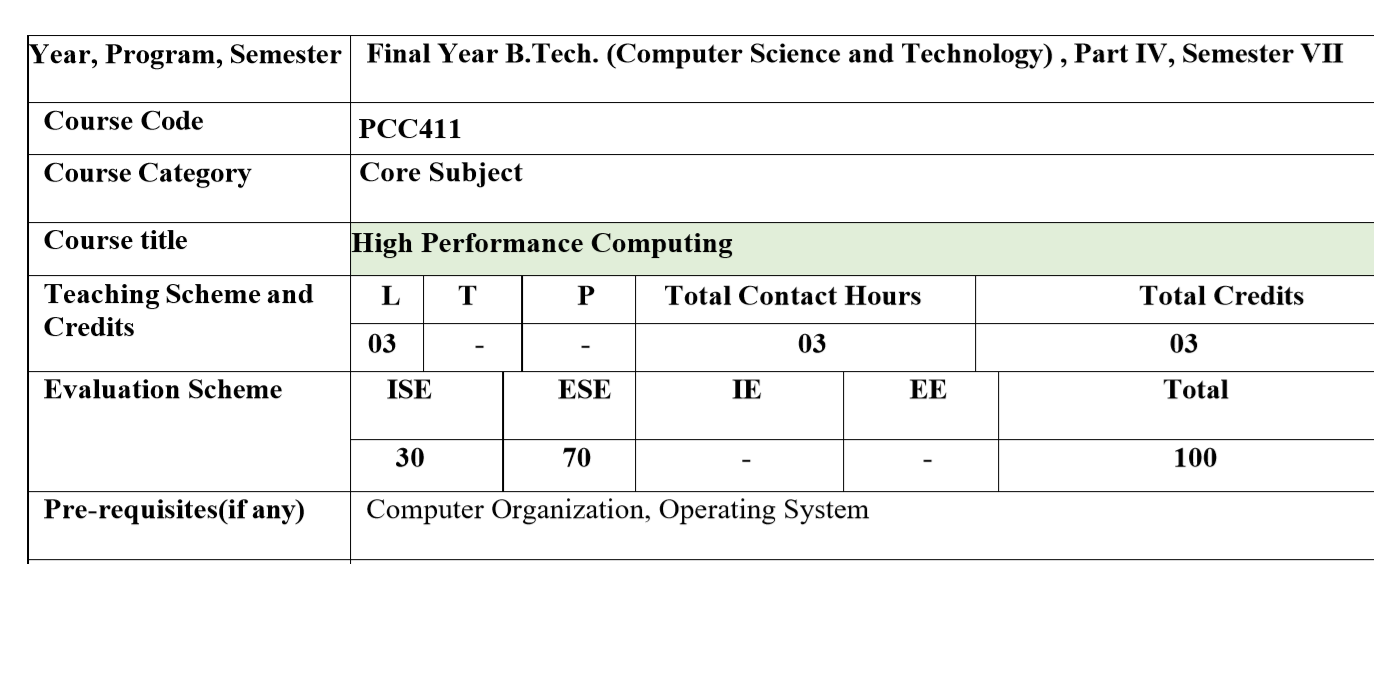
The Course is aimed to: 1. Provide detail knowledge of different Parallel Architectures 2. Analyze performance measures for evaluation of parallel architectures and pipeline processors 3. Provide details of multitasking architecture and Latency hiding techniques 4. Provide details of processor topology and multiprogramming architectures 5. Provide details of data flow architecture and data flow programming language 6. Analyze modes of programming parallel architectures
Upon completion of this course, student should be able to –
1. Classify parallel architectures 2. Analyze and evaluate parallel architectures and describe pipelined processors. 3. Understand concept of multitasking architecture and Latency hiding techniques 4. Design processor topology and understand basics multiprogramming architectures 5. Understand data flow architecture and data flow programming language 6. Analyze and understand modes of programming parallel architectures
- Teacher: MUKESH KUMAR -
- Teacher: PRATIKSHA ALAPURE
- Teacher: PRADNYA AMBURLE
- Teacher: Malhotra Ansh
- Teacher: SHARMA ANSHIKA
- Teacher: YASHOVARDHAN AWALE
- Teacher: SAYALI BACHAL
- Teacher: SARVESH BARGE
- Teacher: SAKSHI BHANUSE
- Teacher: MUKTA BHOSALE
- Teacher: PRASAD BINAWADE
- Teacher: SHRIHARI CHAUDHARI
- Teacher: ASMITA CHAVAN
- Teacher: Sejal Chikode
- Teacher: ANJALI CHIMANE
- Teacher: ARKAN DESAI
- Teacher: SALONI DEVDAS
- Teacher: SHRAVANI DHAVALE
- Teacher: AMRUT DONGRE
- Teacher: SAHIL DUDHANE
- Teacher: PRANAV EDAKE
- Teacher: PRATIKSHA EKSHINGE
- Teacher: NEIL FERNANDIS
- Teacher: RUSHIKESH FULMALI
- Teacher: KRUTIKA GADIWAN
- Teacher: JANHAVI GAIKWAD
- Teacher: PRITESH GHADGE
- Teacher: SAMIKSHA GHURE
- Teacher: VEDANTI GODASE
- Teacher: PRAGATI GOSAVI
- Teacher: PRATIKSHA GOSAVI
- Teacher: SNEHA GUPTA
- Teacher: ANUP GURAV
- Teacher: SHREYA HANDE
- Teacher: VERMA HARSHIL
- Teacher: SRUSHTI HAVAL
- Teacher: CHARAK HIMANSHU
- Teacher: ADITYA JADHAV
- Teacher: PRANAV JADHAV
- Teacher: SAKSHI JADHAV
- Teacher: SWATI JAGTAP
- Teacher: TANUJA JANGILWAD
- Teacher: SHRADDHA JEURKAR
- Teacher: DATTARAJ KADAM
- Teacher: SRUSHTI KALE
- Teacher: AMEY KAMBLE
- Teacher: SAIPRASAD KAMBLE
- Teacher: NEHA KAMU
- Teacher: KARAN KARAD
- Teacher: ATHARV KAREKAR
- Teacher: SMRITI KARNA
- Teacher: MAYURI KARPE
- Teacher: VISHAL KASALE
- Teacher: SHRADDHA KASAR
- Teacher: NEHA KATKE
- Teacher: KARTIK KESARKAR
- Teacher: Hridaynath Khandagale
- Teacher: GAYATRI KHANDEKAR
- Teacher: PRASANNA KORE
- Teacher: PRIYANKA KULKARNI
- Teacher: Omkar Kumbhar
- Teacher: SAKSHI KUMBHAR
- Teacher: KANCHAN KURE
- Teacher: ADITYA KURUM
- Teacher: AISHWARYA LOHAR
- Teacher: SHRADDHA MAGDUM
- Teacher: SHRUTIKA MAHADIK
- Teacher: BHAGYASHRI MANDALE
- Teacher: TANVI MANE
- Teacher: VAIDEHI MANGRULE
- Teacher: Amrita Manjrekar
- Teacher: PAVAN MARDIKAR
- Teacher: SONALI MARGALE
- Teacher: OMKAR MASTMARDI
- Teacher: RUTUJA MOHITE
- Teacher: SHRIVARDHAN MOHITE
- Teacher: VARAD MOKASHI
- Teacher: VAISHNAVI MORE
- Teacher: KOUSAR MUJAWAR
- Teacher: ARYA MUJUMDAR
- Teacher: AMISHA MULANI
- Teacher: IRAM MULLA
- Teacher: KUNAL MULLEWAR
- Teacher: ANKITA NADARGE
- Teacher: GANESH NAGRE
- Teacher: AKSHATA NANADIKAR
- Teacher: SHIVANI NAWALE
- Teacher: SHRIDHAR NIMBALKAR
- Teacher: PRANALI OULKAR
- Teacher: NUTAN PATADE
- Teacher: PRAJAKTA PATE
- Teacher: ASHISH PATIL
- Teacher: BHARGAVI PATIL
- Teacher: DHIRAJ PATIL
- Teacher: HARSHWARDHAN PATIL
- Teacher: SANIKA PATIL
- Teacher: SHANTANU PATIL
- Teacher: SHRADHA PATIL
- Teacher: SIDDHI PATIL
- Teacher: SWATI PATIL
- Teacher: UMESH PATIL
- Teacher: VIKAS PATIL
- Teacher: VIKRAM PATIL
- Teacher: ATHARVA PAVALE
- Teacher: PRATIKSHA PAWAR
- Teacher: PRIYANKA PAWAR
- Teacher: SAKSHI PAWAR
- Teacher: SAKSHI PAWAR
- Teacher: SAMIKSHA PAWAR
- Teacher: VIRAJ POWAR
- Teacher: DEVI RADHIKA
- Teacher: ANIRUDHA RANBHISE
- Teacher: GUPTA RASHMI
- Teacher: HARSHVARDHAN ROKADE
- Teacher: SAHIL SADIGALE
- Teacher: POOJA SALUNKE
- Teacher: TANUSHRI SANGAONKAR
- Teacher: SOUMIL SATHE
- Teacher: NEHA SAWANT
- Teacher: PRATHMESH SHAHANE
- Teacher: AMAN SHAIKH
- Teacher: QURRATUL ASFIYA SHAIKH
- Teacher: AISHWARYA SHINDE
- Teacher: MANASI SHINDE
- Teacher: Aditya Sonwane
- Teacher: GAURAV SURYAWANSHI
- Teacher: SHRIJAY TALAP
- Teacher: KALYANI TARADE
- Teacher: Narendra Tayde
- Teacher: PARTH TEMBHARE
- Teacher: MRUNALINI THORAT
- Teacher: PRANALI THORAT
- Teacher: RUSHIKESH THORAT
- Teacher: SAMIKSHA UNDARE
- Teacher: HRISHIKESH VARAK
- Teacher: HARSHAD VITEKAR
- Teacher: BHUSHAN WAGHMARE
- Teacher: NILKANTESH WAGHMARE
- Teacher: PRANAV WAGHMODE
- Teacher: ROHAN WAYADANDE
- Teacher: NEHA YADAV
- Teacher: RAJ YADAV
- Teacher: RUSHIKESH YALMAR
- Teacher: TANISHA YELPALE
